

RecRoomMasters
Why Bars and Restaurants Add Arcade Cabinets for Traffic
Oct
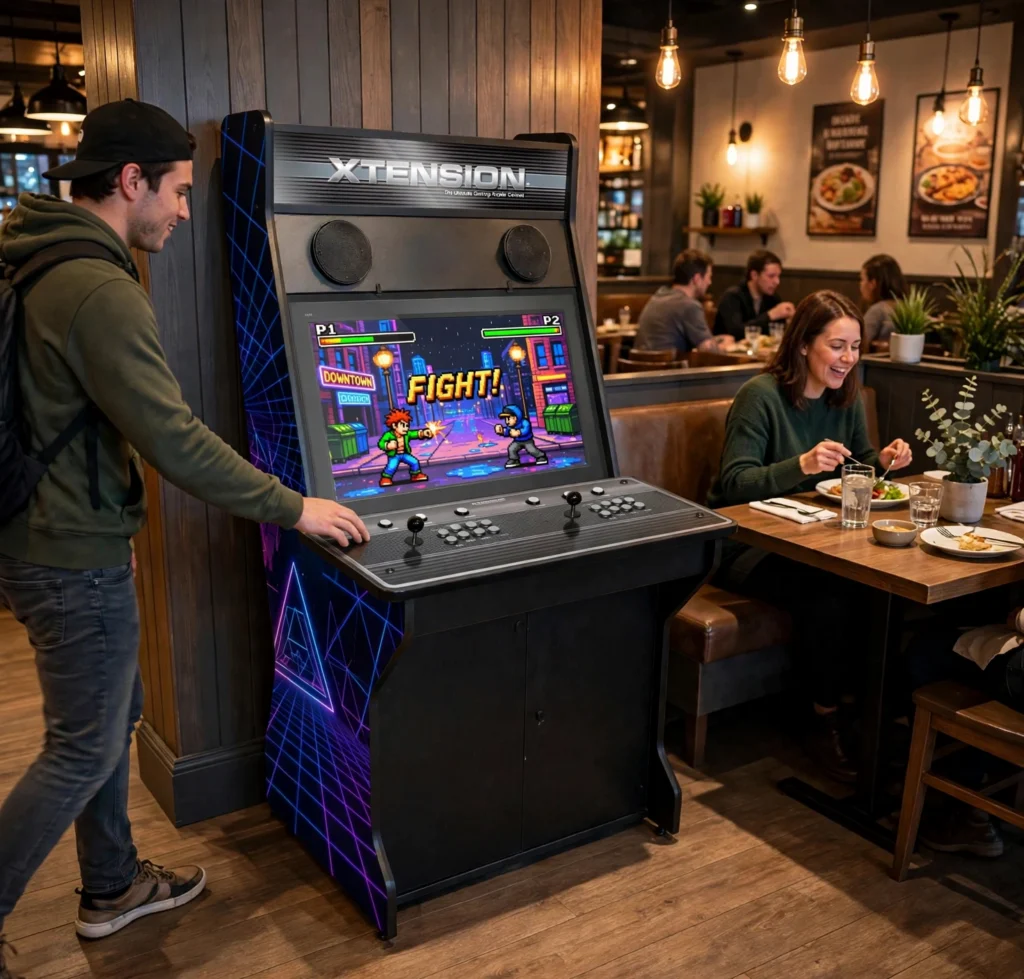
Restaurant and bar margins leave little room for guessing. When traffic softens, every square foot and every guest minute has to work harder. That is why more operators are adding arcade cabinets to their rooms, not as novelty décor but as a behavioral tool that gives guests a reason to stay, return, and bring friends.
This analysis examines what an arcade cabinet actually does for a hospitality business. We will cover the traffic problem it solves, the guest behavior shifts that follow, and the revenue model choice between free play and coin operation. You will learn how to plan placement and space, build a defensible ROI case around dwell time, group visits, and repeat trips, and treat social media as a secondary benefit rather than the strategy. We will also review what commercial placement demands and how to select a cabinet that survives a busy room. By the end, you will have three concrete next moves for evaluating the investment in your venue.
The Foot Traffic Problem Arcade Cabinets Solve
The National Restaurant Association’s 2026 State of the Restaurant Industry report projects U.S. restaurant sales reaching US$1.55 trillion in 2026 despite a challenging business environment. The methodology was not reviewed here, so treat that figure as directional rather than precise.
Many operators find their real competition extends beyond the bar down the street, streaming, delivery, and entertainment venues that bundle food with an activity all compete for the same leisure occasion.
Foot traffic is the metric you can actually move. Once a guest is inside, every extra minute is another chance at a drink, a dessert, or an appetizer.
Many operators find that heavy discounting trains regulars to wait for a deal rather than visit at full price. An activity gives them a reason to choose you at full price on a Tuesday. An arcade cabinet is a relatively low-cost entertainment asset you can add without a build-out, unlike a kitchen remodel, a patio, or a full concept change. Sourcing one built for real wear starts with knowing why Rec Room Masters stands apart from other arcade cabinet builders.
Why an Arcade Cabinet Changes Guest Behavior, Not Just the Room
An arcade cabinet works on guest behaviour, not floor plan. A game can absorb the dead time created by a wait for a table, for food, or for a late friend, converting idle minutes into minutes spent at the bar or table. Groups anchor there too: a cabinet gives them a meeting point and a shared activity, and groups that arrive together tend to order together and stay longer than solo guests. Head-to-head play adds rotation and spectating, so people who never touch the controls still stay longer while a small corner of the room stays busy. Rotating titles, score challenges, and a weekly league night can give guests a specific, scheduled reason to return on a slow Tuesday.
Be honest about the evidence. No industry data measures this directly, so run your own pre/post test.
Free Play vs. Coin Operated: Choosing the Right Revenue Model
Two models, two goals. Free play buys time in seat and a higher average check. Coin operation buys direct per-play revenue and a cabinet that funds itself.
Five variables decide it: cabinet cost, expected plays per night, your food and beverage attachment rate, labour to service coin mechanisms, and licensing or amusement-device fees. A brewery or cafe with strong food sales usually converts plays into tabs. A high-volume bar with low food attachment often earns more from coin or token play.
Illustrative payback, all inputs assumptions: $3,000 cabinet, 40 plays per night at $1, 26 nights monthly, 50% net retained after tax, licensing, and coin-handling labour. That is $520 monthly, or roughly 5.8 months. Change any input and the answer moves.
Compliance first. Rules on amusement devices and coin-operated machine taxes vary by province, state, and municipality; some jurisdictions levy direct taxes on coin-operated machines. Confirm local licensing and permit requirements before you order. Pick the goal, then the model that funds it.
Free Play: Trading Coin Revenue for Time in Seat
Free play strips out the transaction that stops a curious guest from ever pressing start. When dwell time is the goal, that friction works against you.
Typical setups: switch the cabinet to free play mode, disable the coin mechanism entirely, or post a house rule that games come with any purchase.
Then track it. Free play only wins if the added minutes and the larger tab beat the coin revenue you gave up, so pull average check and table turns for two weeks before and after. Disabling a coin slot may not change how your province or state classifies the machine for licensing or amusement tax, so confirm with your revenue authority.
Watch the failure mode: a free-play cabinet can become a babysitting station that holds seats without spending. Place it away from prime tables, favouring a compact upright cabinet over a sit-down build, and set a clear rule on minors.
Finally, market it. A table tent or a menu line reading “games are on the house” turns the cabinet into a visible reason to choose your venue.
Coin Operated: Direct Revenue and a Different Guest
Coin operation reverses that trade: the cabinet funds its own footprint, which matters when you want the asset to justify itself.
Tokens or card systems are generally easier to reconcile than loose change and may reduce handling errors, confirm the trade-off against your venue’s actual coin volume.
Be realistic about scale. One cabinet in a small venue is an amenity with a modest income stream, not a revenue centre. Model it that way and you will not be disappointed.
Servicing is the hidden cost. Coin mechs jam, bill validators fail, and cash still needs collection and reconciliation. Assign that work to a named role, not to whoever notices. A spare parts plan helps; see this arcade cabinet parts checklist for the components worth stocking.
Some operators report coin play draws guests into quieter early-evening hours, test this against your own daypart data before relying on it.
Placement and Space Planning: Where the Cabinet Actually Goes
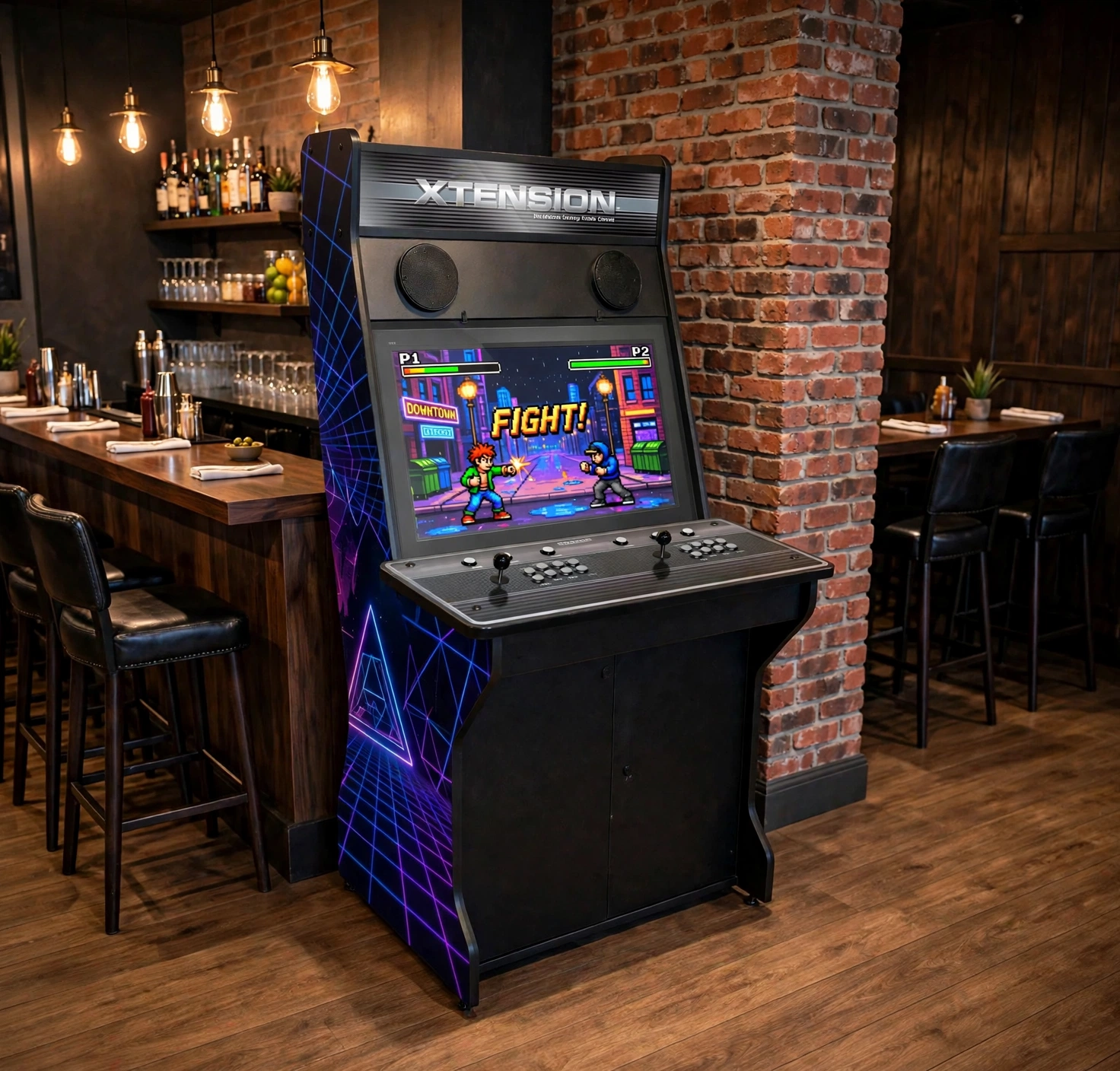
Whichever model you choose, placement decides whether the cabinet earns its keep. Plan the footprint before ordering: an upright cabinet’s footprint varies by model, confirm the exact dimensions from the manufacturer spec sheet before committing to a location, but players, spectators, and service access all need clearance beside and behind it. Power deserves equal attention. Specify a dedicated outlet, GFCI protection where your code requires it, surge protection for a machine powered all night, and cord routing that never crosses a walkway; consult a licensed electrician for your jurisdiction’s specific requirements. Sightlines are the difference between an asset and decor. Staff must see the cabinet to monitor it; guests must see it to play it. A back hallway hides it, while a spot along the entry path gets noticed. Respect noise adjacency too, since game audio and button noise carry further than expected. Keep it away from quiet dining sections and premium tables. Confirm fire code egress, ADA path-of-travel clearance, and local amusement device licensing before committing to a location. For installation specifics, see our room layout, clearance, and lighting tips. Get placement right, and the payback math starts from a stronger position.
The ROI Case: Dwell Time, Group Visits, and Repeat Trips
With placement settled, the question becomes whether the cabinet earns its floor space. Build the model from your own baseline: average check divided by average dwell time gives your per-minute spend rate; then estimate the extra minutes a game plausibly adds.
The equation is simple: incremental dwell (minutes) × per-minute spend rate × guests affected = incremental revenue. Example, all inputs labelled as estimates: 15 extra minutes × $0.40 per minute × 130 guests per month = $780 monthly revenue. At 65% gross margin, that is about $507.
Group visits offer the strongest case. In many venues, birthday parties, team outings, and private events anecdotally arrive with a head count, spend more per person, and fill otherwise quiet nights. Repeat trips are the durable driver: a weekly score challenge, bracket tournament, or casual league gives guests a scheduled reason to return, compounding traffic in a way novelty cannot.
The conservative case may never pay back, say so in your model. Exclude social media from the calculation.
The Social Media Upside, and Why It Is Not the Strategy
Set aside the payback model and consider the marketing angle. Vintage arcade cabinets tend to photograph well: bold marquees, glowing screens, and control panels that read instantly in a quick phone snap. That gives guests a natural reason to post and tag your venue.
Three low-cost tactics: a branded hashtag, a small sign inviting tags, and a well-lit arcade corner that photographs clearly without staging. Still deciding how much variety that corner needs? This Canadian buyer’s guide to multi-game emulation covers it.
Be honest about the evidence, though. No captured data links cabinets to measurable social reach, so frame this as potential upside, not a line item you can bank on. Where it does pay is content supply: user-generated photos lower production cost and keep real venue images flowing into ads, listings, and menus (obtain guest consent before reusing any photo in paid placements, and note that image reuse carries rights considerations).
Keep the priority straight. Social attention fades fast. The guest who returns because they had a good time in the room is the asset that actually moves your covers.
What Commercial Placement Really Requires
Social reach is the upside; a cabinet that never gets serviced is the downside. Start with assembly. Budget assembly labour as a real line item, details on what that build entails are in the cabinet selection section. Controllers are the exception: Rec Room Masters ships them as self-assembly kits with the controllers pre-assembled, turning a worn joystick into a fast swap rather than a repair project. If a cheaper route tempts you, first read what a DIY arcade kit actually includes.
Staffing is not optional. Add the cabinet to your opening and closing checklists so it is powered up, wiped down, reset, and monitored consistently. Plan maintenance before you need it: joysticks, buttons, marquee lighting, screens, and high-touch surfaces wear faster in a public room than in a home game room. Loop in your insurer, confirm coverage for a guest-facing amusement device, and post simple rules for use. Treat it as equipment you are responsible for, not furniture.
Choosing a Cabinet That Survives a Commercial Room
With the operational plan settled, the purchase decision comes down to build quality, not feature count. Thicker panels, quality joysticks and buttons, and serviceable internals outlast a long game list in a room where the cabinet runs every night.
Duty rating deserves candour. Verify the intended duty rating for any cabinet you consider, confirm with the manufacturer whether it is rated for the hours a commercial room demands, and get that confirmation in writing. This applies to Rec Room Masters models as much as any other brand.
Multi-game capability serves groups better than a single-title machine. A two or four player control panel turns the cabinet into a social station rather than a solo distraction.
Self-assembly also means flat-packed delivery, easier to get through tight doorways and to relocate later.
Confirm five specs before purchase: dimensions, weight, power draw, control panel layout, and how replacement parts are sourced and shipped.
Your Next Three Moves
With specs confirmed, the rest is discipline. Before you order, record average dwell time, average check, and weekday cover counts for two to four weeks. That baseline is the only honest benchmark you will have.
Then model payback with every assumption labelled: cabinet cost, plays or tabs per night, labour, maintenance, and local licensing fees. Pick free play, coin operated, or a hybrid based on how your guests already spend, not on theory.
Choose a cabinet you can service and a spot you can supervise. Book a 90-day review comparing dwell time, check average, and repeat visits against your baseline.
The takeaway is blunt: if the cabinet does not beat those numbers, it is decor, not an investment. Buy it for the business case, or do not buy it at all.
Conclusion
An arcade cabinet can do more than fill a corner. It can extend dwell time, turn tables into group stations, and give guests a reason to return. Follow the three-move framework above, baseline, payback model, 90-day review, and you will know within a quarter whether the cabinet earns its space.
Frequently Asked Questions
Do bar customers need instructions to play?
No. The Xtension cabinets run a simple game-select interface, so walk-up guests can pick a game and start playing with no staff help.
Can I charge customers per play?
Yes. Add a coin door (+$50 or +$80 depending on model) and a locking cash door (+$30) to run the cabinet coin-operated.
How much does a venue-ready cabinet cost?
A 2-player upright starts at $1,095; the default trackball configuration is $1,195. Coin door and locking door are add-ons.
Is assembly difficult?
No. Cabinets ship as self-assembly kits with the controllers pre-assembled and the control panel integrated flush into the cabinet top — most venues have it together in an afternoon.
Do you ship to Canada?
Yes. Rec Room Masters ships to addresses across the USA and Canada.
