

RecRoomMasters
How Airbnb Hosts Can Use Arcade Cabinets to Attract Families and Boost Bookings
Sep
What if one simple addition to your Airbnb could make families choose your listing over every other option in your market? Not a renovation. Not a pool. Just a classic arcade cabinet sitting in your living room, ready to light up the moment guests walk through the door.
Hosts who are serious about standing out in 2025 and beyond are learning fast that generic amenities no longer move the needle. Guests are not just booking a place to sleep. They are booking an experience, and families traveling with kids are actively hunting for properties that give them something to do together. Arcade games for Airbnb are quietly becoming one of the smartest differentiators a host can add.
In this guide, you will learn why the amenity landscape is shifting, how the family travel segment is being underserved by most listings, and exactly what to look for when buying a cabinet for your property. You will also discover how the Arcade1Up system makes the guest experience completely headache-free, and how to turn this investment into a real boost for your bookings and bottom line.
Why Amenities Are Now the Deciding Factor for Airbnb Bookings
With over 7 million Airbnb listings across 220 countries and 5.5 million hosts all competing for the same bookings, having a clean, comfortable space no longer cuts it. Guests have options, and they know it. Amenities have become the deciding factor.
The data backs this up. Hot tubs deliver a 38% RevPAR boost, with listings charging $303 per night versus $228 without one. Pools add 30%, pushing nightly rates from $234 to $295. These are not marginal gains; they compound across an entire booking calendar.
The Gatlinburg, TN market makes the stakes concrete. Listings with hot tubs earn more annually than those without, a revenue gap that can exceed six figures across a booking calendar. Even among hosts who already have amenities, the gap between top performers and median listings is significant. If your listing sits in the middle tier, that number represents real money left on the table.
Here is the catch: not every host can add a hot tub or pool. Condo rules, limited outdoor space, cold climates, and local regulations take those options off the table for a significant portion of hosts.
That gap is exactly where experience amenities come in. Amenities that create emotional memories, shared moments, and genuine fun, without requiring a contractor or a permit, are increasingly outperforming generic upgrades. For hosts who cannot go the infrastructure route, the opportunity to differentiate is still very much open.
The 2026 ‘Whycation’ Trend Is Reshaping What Guests Actually Want
Here is what the data actually shows: guests are no longer booking based on where a property is located. They are booking based on how they expect to feel when they get there.
Hilton’s 2026 Trends Report, which surveyed 14,009 travellers across 14 countries, found that 56% of people now list “rest and recharge” as their primary motivation for leisure travel. Destination is secondary. Feeling is the decision driver.
That shift has a direct revenue implication. When guests are chasing an emotional outcome, they extend their stays to protect it. Nearly half of travellers are adding extra nights specifically to preserve a restorative experience, which means more revenue per booking with no additional marketing spend.
So what actually delivers that emotional payoff? Not a bigger TV. A 65-inch screen is a passive feature; it does not create a memory. Fire pits, outdoor kitchens, and game rooms are increasingly cited by experience-driven guests as highlights of their stay, precisely because they generate active, shared moments rather than passive ones.
This is exactly where an arcade cabinet earns its place. The cabinet is not a feature. It is a story your guests will tell. Hosts who grasp that distinction can write listing descriptions and choose photos that sell the feeling of a stay, not just its specs, and that is a meaningful competitive edge.
Families Are an Underserved Segment in the Premium Amenity Conversation
The emotional motivation research is compelling, but notice what it misses: almost every high-ROI amenity benchmark (hot tubs, gyms, pools) is engineered around individual wellness or solo remote work. Nobody has seriously claimed the family group experience category yet. That’s a first-mover opening hiding in plain sight.
Families represented roughly 48% of vacation rental demand in 2025, and family bookings behave differently from solo or couple stays. They run longer, travel in larger groups, and cluster around school breaks, precisely when occupancy demand spikes and nightly rates have the most upward flexibility. More nights per booking, more guests per night, during peak periods: that’s a compounding revenue profile.
Here’s the detail most hosts overlook: kids engage with the arcade in a way they rarely do with a hot tub or coffee maker, and families who connect an experience with a specific property tend to return and recommend it.
Multi-generational travel adds another layer. Grandparents, parents, and children travelling together represent a growing segment with one specific problem: finding entertainment that works for everyone. An arcade cabinet solves that problem in a way a streaming service or board game shelf cannot. It bridges the age gap in one piece of furniture.
Before you decide between a standing cabinet or a cocktail-style build, see the comparison of upright vs. sit-down arcade cabinets on the Rec Room Masters site to match the right footprint to your space. In markets already saturated with hot tub and pool listings, this is how you differentiate without a five-figure infrastructure project.
Why an Arcade Cabinet Works Better Than Other Entertainment Upgrades
Targeting families is a smart play, but the amenity still has to deliver on the ground. That’s where an arcade cabinet separates itself from every other entertainment upgrade a host might consider.
A classic arcade cabinet powers on and plays, no accounts, updates, or missing remotes required. That frictionless experience is rare in modern electronics, and guests notice immediately.
The nostalgia factor works in both directions. Parents who spent quarters at the arcade in the ’80s and ’90s feel something real when they see a cabinet. Kids who have never seen one experience something genuinely new. That cross-generational spark is nearly impossible to replicate with a console or tablet dock.
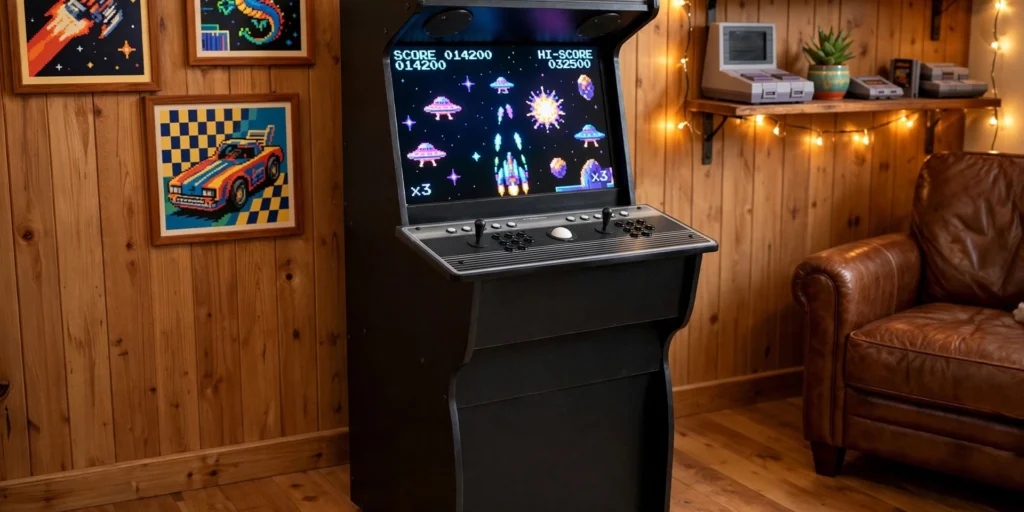
In listing photos, it stops the scroll. A lit-up arcade cabinet signals “this host thought about fun” before a guest reads a single word. That visual storytelling earns clicks.
Maintenance is minimal once it’s built. Hot tubs need weekly chemical balancing; pools need seasonal care. A well-built cabinet, assembled from quality arcade cabinet parts designed for sustained play, asks very little after setup.
And it doesn’t age out. A smart TV becomes a baseline expectation within two years. Retro gaming is tied to memory and culture rather than a product cycle, so a quality cabinet from a DIY Xtension build holds its novelty far longer than any screen upgrade you could make.
How the Arcade1Up Interface Solves the Biggest Guest Experience Problem
A self-contained cabinet that just works is a genuine selling point. But “just works” only holds up if the interface backs it up.
The most common reason hosts hesitate to add entertainment amenities isn’t cost; it’s the mental image of a guest message at 9 p.m. asking how to turn something on. An amenity guests cannot figure out quickly stops being a perk and starts generating complaints disproportionate to the actual problem.
According to the manufacturer, the arcade-one.com interface is designed for walk-up usability: guests select a game and play. No account creation, no pairing screens, no firmware prompts. The whole experience is designed around someone who has never touched that specific cabinet before.
That frictionless design connects directly to review quality. Airbnb guests rate their stay across multiple dimensions, including whether everything ran smoothly. When an amenity exceeds expectations with zero intervention, guests mention it by name in their reviews. When it requires even minor troubleshooting, the complaint lands harder than the issue warrants.
Compare that to a gaming console requiring a shared account login or a DIY setup needing a reboot routine. Both create support exposure that a properly designed arcade cabinet eliminates completely.
For hosts managing more than one property or listing remotely, this matters at scale. A plug-and-play system means the arcade cabinet works the same way in every unit, without needing a local contact on standby. That’s what makes it a scalable amenity addition rather than a one-property experiment.
What to Look for When Buying an Arcade Cabinet for Your Rental Property
Once you’ve confirmed the interface works for your guests, the next question is whether the cabinet itself will hold up to them.
1. Prioritise build quality above everything else. Rental guests are not as careful as owners. Joysticks get yanked, buttons get hammered, and panels take repeated impact from people who have no stake in the hardware. Look for reinforced buttons, commercial-grade joysticks, and solid panel construction. Rec Room Masters builds with premium components specifically rated for high-turnover play.
2. Game library breadth keeps novelty alive across multiple nights. A single-game cabinet loses its appeal by day two. Dozens of classic titles gives every family member something to return to, directly supporting longer stays and better reviews.
3. Measure before you buy. Confirm dimensions work for your space without blocking walkways or creating an egress issue. This is a safety and liability consideration. If you’re weighing a budget DIY option, the breakdown of what a Raspberry Pi arcade cabinet kit actually includes on the Rec Room Masters site is worth reading before you commit.
4. Self-assembly keeps costs and logistics manageable. Rec Room Masters cabinets ship as self-assembly builds with no professional installation required. Hosts comfortable with basic assembly can set up on their own schedule, and the cost savings versus a pre-built unit improves overall payback.
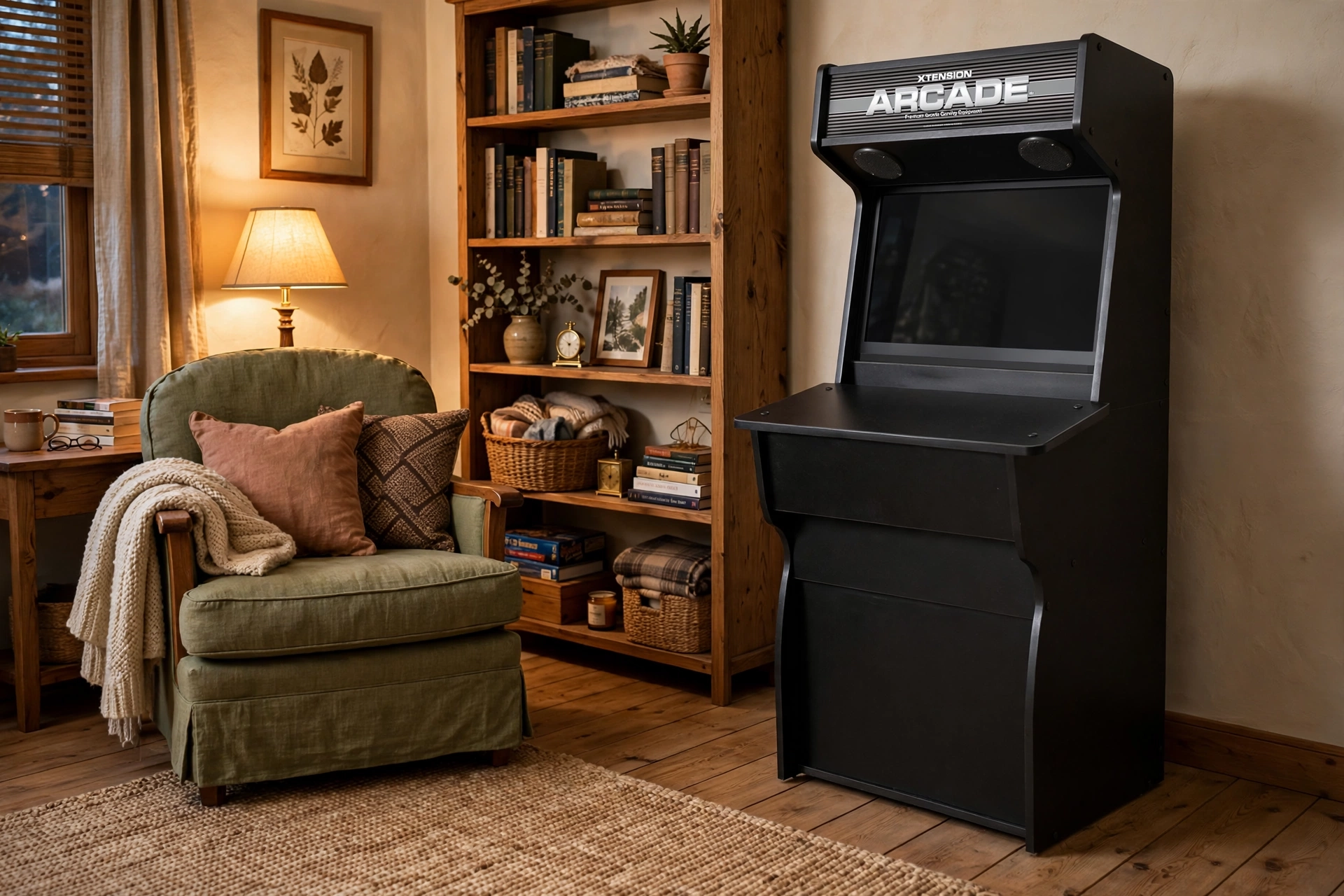
5. Aesthetic fit affects your listing photos, not just your floor. A cabinet with a clean art wrap can enhance your listing’s visual story. Look for customisable artwork options that complement your property’s existing decor rather than clashing with it.
How to Market Your Arcade Cabinet on Your Airbnb Listing for Maximum Impact
Once your cabinet is placed, how you present it on your listing does most of the revenue work.
Lead with a photo that sells the feeling. Put a shot of the cabinet at the front of your gallery with the screen lit up and the surrounding space visible. Guests browsing thumbnails make split-second decisions; that glowing screen signals “fun property” before they click through.
Build the keyword into your title. Phrases like “arcade game room” or “classic arcade cabinet” are what family travellers type into search. One of those terms in your title puts you in front of the right guests before they read your description. The guide to how many games an Xtension cabinet can run for Canadian buyers on the Rec Room Masters site shows how broad that library can be.
Describe the experience, not the specs. “Kids and parents compete for high scores after dinner” is more compelling than “includes multi-game arcade cabinet.” Write the moment, not the feature.
Tag it explicitly. Arcade cabinet may not appear as a default Airbnb amenity category, but naming it clearly in your house manual and description ensures it surfaces in keyword-based search.
Ask for the review mention. In your checkout message, invite families to share what they enjoyed. Guest-written phrases like “the kids loved the arcade” carry more weight with the next family than anything you write yourself.
Building the ROI Case: Thinking About Arcade Cabinets as a Tier-2 Amenity Investment
Good news first: the investment logic here is genuinely sound, even without a published benchmark to lean on.
Experience amenity benchmarks are well documented, the data gap is specific to arcade cabinets, and that gap is worth acknowledging honestly. Published data tracks hot tubs at +38% RevPAR and pools at +30%. But the underlying logic holds: experience amenities consistently outperform passive ones, and a cabinet’s ROI profile tracks far closer to a fire pit than a flat-screen TV. Both create moments; one gets mentioned in reviews, the other gets ignored.
The cost structure also works in the cabinet’s favour. A Rec Room Masters cabinet is a one-time capital purchase with no seasonal shutdown and no meaningful utility surcharge. A hot tub carries ongoing maintenance that compounds over three to five years. When you compare total cost of ownership against attributed revenue, the cabinet’s per-dollar return holds up well, particularly for hosts blocked from a hot tub or pool by HOA rules, climate, or floor plan.
On payback: even a modest nightly rate increase, positioned as a premium family-friendly listing, can meaningfully improve payback speed, though hosts should track their own booking data to validate the lift in their specific market.
Once the cabinet is live, track three things: booking pace, average length of stay, and review language. Longer stays signal guests are staying to enjoy it; review mentions give you copy you can use directly. Those metrics tell you whether the investment is compounding, and they give you a credible story for why Rec Room Masters stands apart from other arcade cabinet builders when guests ask what cabinet you have.
The Bottom Line for Hosts Ready to Level Up Their Listings
The investment case builds on its own. As covered above, experience amenities consistently outperform passive upgrades, and families remain an underserved booking segment with real purchasing power.
For the cabinet itself, Rec Room Masters is the right starting point. Their cabinets are built with premium components designed for sustained, repeated use, and the self-assembly model keeps your upfront cost manageable. Before you build, work through a solid arcade cabinet parts checklist to confirm what you need before you start, so you’re not pausing mid-build to track down missing components.
The timing argument is straightforward: gaming and entertainment amenities are an emerging niche in short-term rental analytics. That’s not a gap to wait out; it’s a window. Hosts who add this amenity now claim the niche before it becomes a standard expectation in family-friendly markets.
When your competitors are still thinking about it, you could already be earning five-star reviews that mention the arcade by name.
Browse cabinet options at recroommasters.com and find the build that fits your space.
Conclusion
If you’re ready to take the step, browse cabinet options at recroommasters.com and find the build that fits your space.
