

RecRoomMasters
Arcade Fight Stick Buying Guide for Canada: When a Standard Controller Isn’t Enough
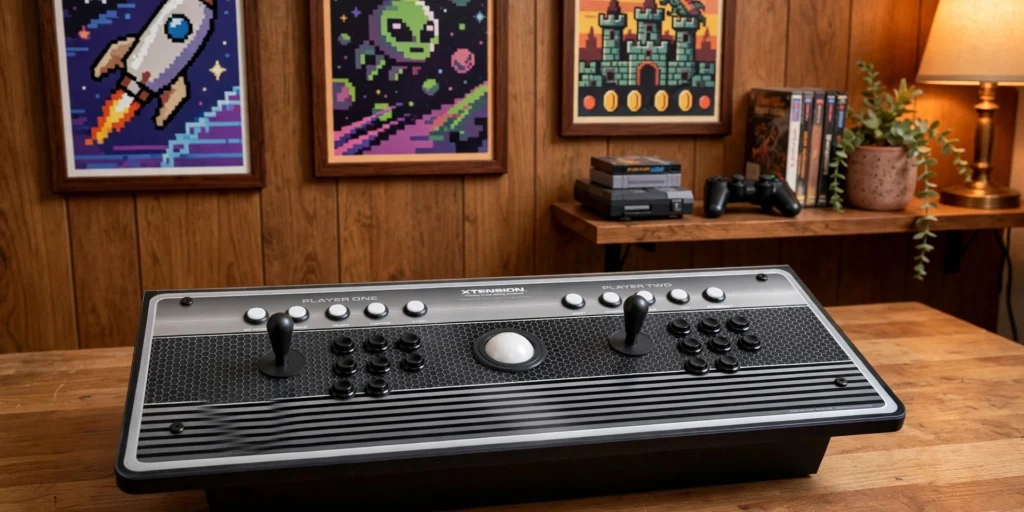
Sep
There comes a moment in every fighting game player’s journey when the gamepad just stops cutting it. Maybe you’re dropping combos you know by heart, or your execution feels inconsistent no matter how much you grind in training mode. That’s usually the sign you’re ready to make the leap to an arcade fight stick, and it’s one of the best upgrades a serious player can make.
For Canadian players, though, this purchase comes with extra layers to think through. Import costs, limited local availability, and platform compatibility questions can turn a straightforward buying decision into a real headache. This guide cuts through all of that. You’ll learn what actually separates a quality arcade fight stick from a cheap one, how to verify platform support before you spend a dollar, and how entry-level, mid-range, and premium options honestly compare. You’ll also discover why a pedestal arcade controller might offer better long-term value than a standalone stick, and how to survive the transition without your ranked record taking a serious hit. Whether you’re buying your first stick or upgrading, this guide gives you a clear path forward.
What Actually Makes an Arcade Fight Stick Good
Not all arcade fight sticks are created equal, and the gap between a quality unit and a budget one shows up in every match.
The lever is the first place to look. Japanese-style levers like the Sanwa JLF are widely regarded in the FGC as using light spring tension and a square gate for crisp, responsive feedback. Korean-style levers like the Fanta are widely regarded in the FGC as running stiffer and springier, with a looser pivot that many Tekken players prefer for fluid movement. Neither is objectively superior; they suit different games and hands. Knowing which you want before you buy saves an expensive lesson.
Buttons matter more than most buyers expect. Arcade-grade buttons use microswitches that actuate with a noticeably lighter, crisper feel than budget alternatives. Budget sticks often substitute membrane or lower-grade switches that feel mushy from day one and degrade faster under heavy use. In a game decided by frame-perfect inputs, that mushiness is a liability.
The PCB is the quiet differentiator. Premium sticks use dedicated boards with minimal polling delay. Entry-level units sometimes borrow circuitry from standard controllers, introducing input latency that is genuinely harmful in frame-tight competitive play.
Build materials determine longevity. Wood or thick ABS panels absorb wrist impact better than thin sheet metal, and a properly weighted base stays put on your lap or desk rather than sliding mid-combo. For more on what separates quality hardware from filler components, Arcade Cabinet Parts Explained: What Every Canadian Builder Needs to Know covers the same quality logic across the broader arcade hardware ecosystem.
Finally, buy something you can mod. A fight stick with an accessible internal compartment lets you swap levers, replace buttons, or upgrade the PCB without retiring the whole unit. A stick you can service lasts years; one you cannot is a countdown timer.
Platform Compatibility: What Canadian Buyers Must Verify First
Even the best joystick and buttons mean nothing if the stick doesn’t talk to your console. This is where a lot of Canadian buyers get burned, and it’s entirely avoidable.
PS5 compatibility is the biggest trap. Many arcade sticks are marketed simply as “PlayStation compatible,” which often means PS4. On a PS5, that same stick may fail to register entirely or drop into a laggy legacy input mode. You need a stick with an explicitly PS5-compatible PCB, confirmed in the product specs before you pay.
Xbox Series X|S has its own version problem. Microsoft’s input driver requirements for the current generation differ from Xbox One’s. A stick certified for Xbox One may require a firmware update or a separate adapter to function on Series X|S, both of which add cost and hassle for anyone ordering across the border.
PC is the forgiving exception. Most quality arcade sticks register cleanly via DirectInput or XInput, and Steam’s controller configuration layer smooths out most edge cases. PC support is the easiest thing to verify and the least likely to disappoint.
Switch support is thin. Only a small subset of sticks include Switch-compatible PCBs, and handheld versus docked mode can introduce additional inconsistencies. Treat Switch compatibility as a bonus rather than something to count on.
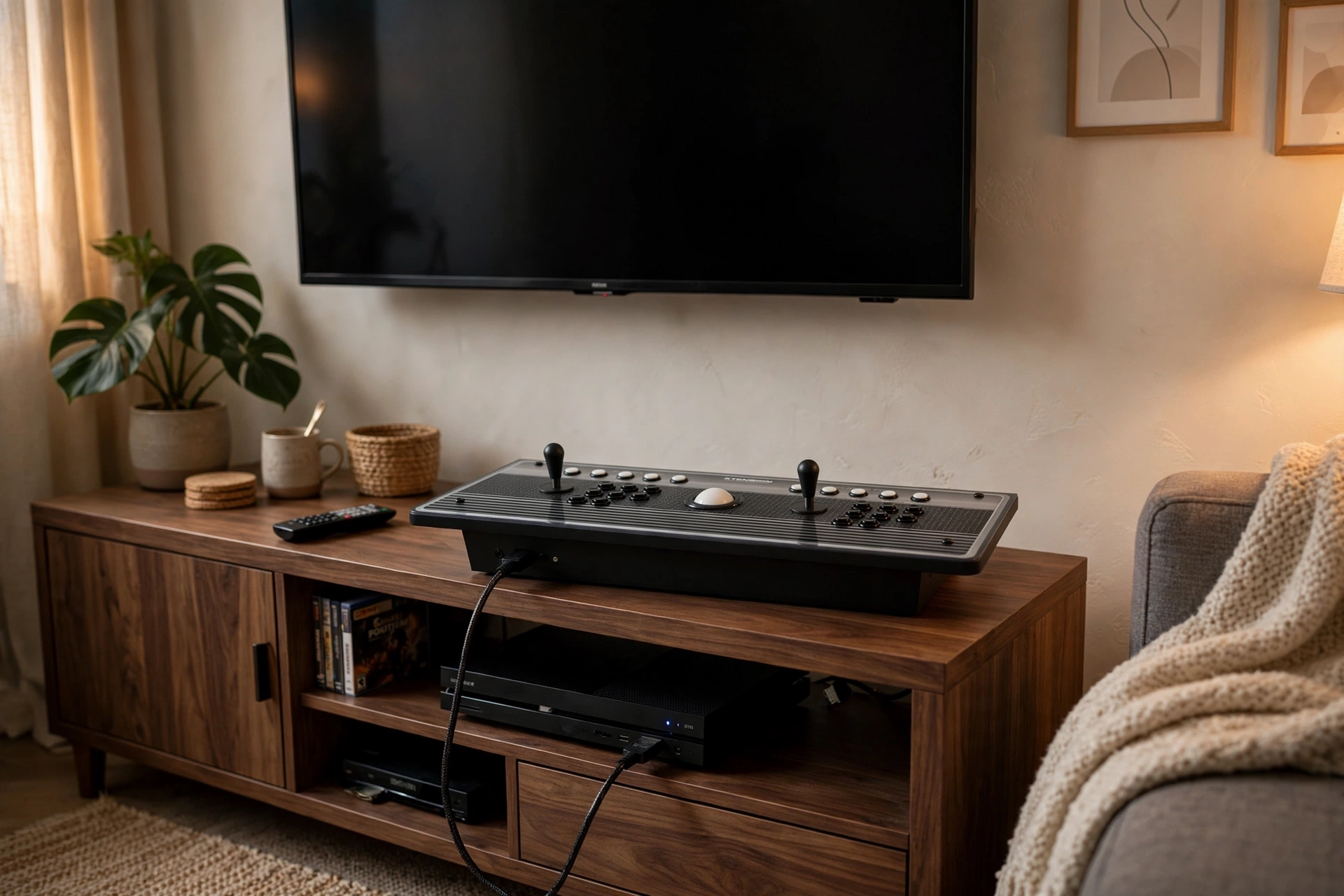
For Canadian buyers, this matters more because cross-border returns are expensive and slow, and some sellers don’t offer return shipping to Canada at all. If you want a controller that covers your bases, the Xtension arcade controller is designed with broad multi-platform support, confirm the current compatibility list with Rec Room Masters before ordering. Compatibility research is always cheaper than a second purchase.
Entry-Level vs. Mid-Range vs. Premium Arcade Sticks: An Honest Breakdown
Once you’ve confirmed compatibility, the next question is how much to spend, and the tier you pick matters more in Canada than elsewhere.
Budget-tier sticks are a fair format test if you genuinely don’t know whether you’ll enjoy a lever. Components are budget-grade, enclosures flex under real session pressure, and PCBs are modest. Fine for a few curious hours; not fine for regular play expecting reliable inputs.
Serious-player-tier sticks are where serious players should start. Authentic Sanwa or equivalent components, solid enclosures, and moddable layouts mean you swap one button or lever when something wears out rather than replacing the whole unit. That upgradability stretches the investment almost indefinitely.
Premium-tier sticks bring refined materials, artisan finishing, and multi-platform PCB support from the factory. For players travelling to tournaments regularly or collectors, the price is justified. For a Canadian playing at home, the performance gap over mid-range is real but narrow and hard to justify on a per-session basis.
Here’s the part nobody advertises: the entry-level false economy. Many players buy cheap, hit component failure or mushy inputs within six to twelve months, then buy mid-range anyway, spending roughly double what one mid-range purchase would have cost.
The CAD conversion makes this worse. A mid-priced USD stick can land at a meaningfully higher CAD figure once currency conversion, duties, and shipping are factored in. That compression practically collapses the gap between entry-level and mid-range on a Canadian doorstep, which is exactly why buying a fully assembled, arcade-grade controller built in the USA and buying it once is such a compelling argument for Canadian players doing the math.
The Canadian Buying Reality: Import Costs, Availability, and Warranty Gaps
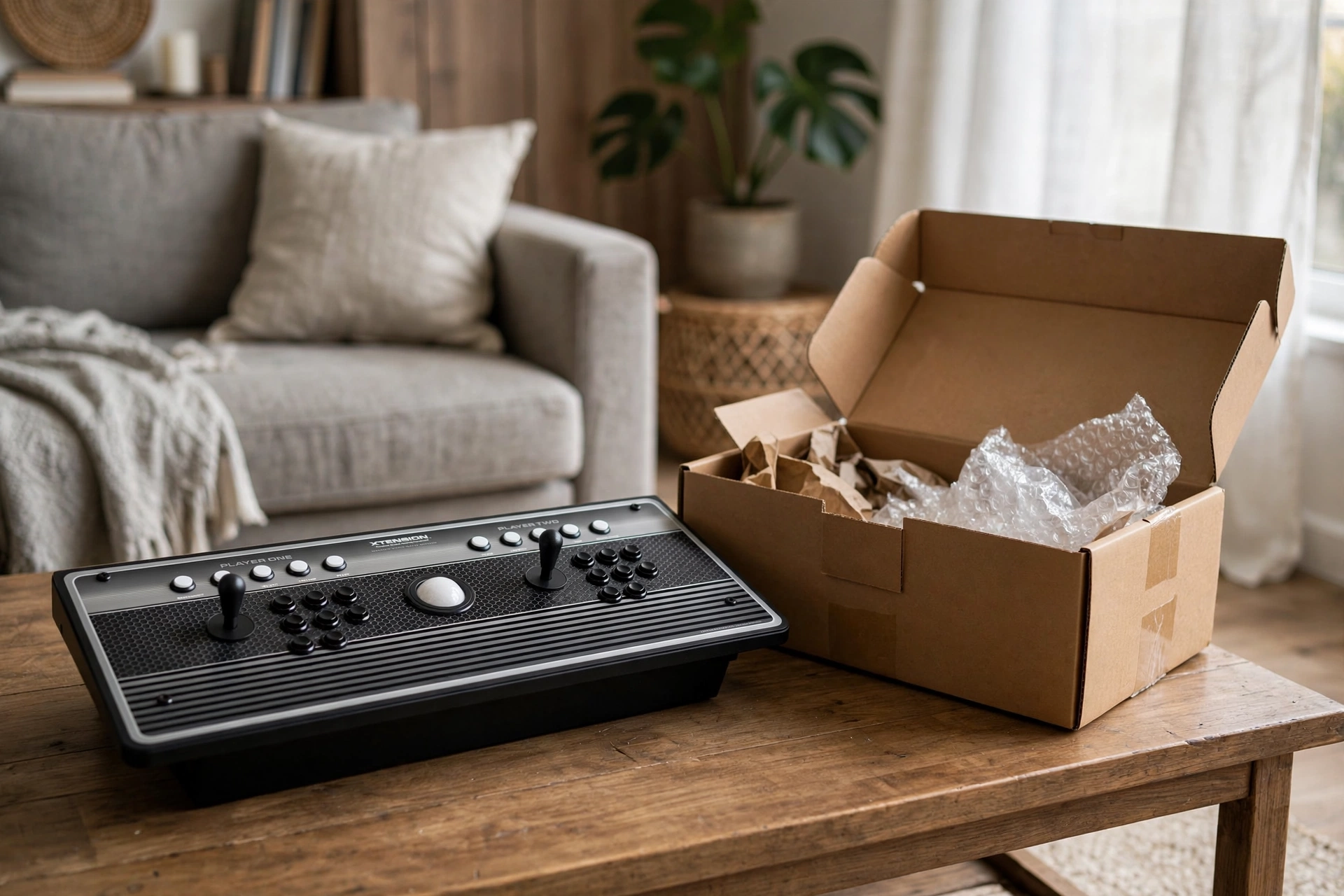
Those CAD conversion numbers only tell part of the story. The sticker price is one thing; what actually lands at your door is another.
Most premium arcade sticks originate in Japan or the United States and ship through online retailers. Canadian buyers routinely absorb brokerage fees, import duties, and cross-border shipping charges that can meaningfully inflate the sticker price, depending on the carrier, the declared value, and Canada’s customs tariff classification. With Canada having imposed tariffs on a broad range of U.S. imports in 2025, that range is trending toward the higher end for American-made hardware.
Warranty service compounds the frustration. Many manufacturers handle claims exclusively through domestic return processes in the U.S. or Japan. Shipping a faulty stick back internationally can cost more than the repair value on a lower-priced unit, which effectively leaves entry-level buyers with no practical warranty recourse.
Retail availability isn’t much help. Large-box electronics retailers stock a narrow selection weighted toward budget units. Specialty arcade hardware is almost entirely an online purchase in Canada, meaning you are committing real money to a product you have almost certainly never held.
The one legitimate free option: Active FGC scenes exist in major Canadian cities including Toronto, Vancouver, and Montreal, and players in those communities sometimes allow prospective buyers to try their gear, worth exploring before committing.
Sourcing from a U.S.-based seller with transparent cross-border shipping and clear warranty terms cuts through most of this friction. It is the same logic that makes building a DIY arcade cabinet kit from a reputable American manufacturer appealing: you know what you are paying, and you know what arrives.
Why a Pedestal Arcade Controller Changes the Long-Term Math
The pedestal format reframes that friction entirely.
A portable arcade stick is built around a compromise: lap or desk use requires a smaller footprint, lighter build, and a playing position your body tolerates rather than enjoys. A pedestal controller is built around the actual position, seated upright, arms forward, control panel at a natural height. That is how the original arcade cabinet was designed, and most players who make the switch describe the difference as immediately obvious.
The Xtension Pedestal Controller, proudly manufactured in the USA by Rec Room Masters, is built on exactly that logic. It ships fully assembled, which separates it from the company’s cabinet kits. It uses full-size arcade-grade joystick and button components, the kind used in quality arcade builds rather than mass-market accessories. Solid, substantial construction means the enclosure absorbs impact rather than flexing under it. The cost-per-session math over a few years looks very different compared to a portable stick whose internals may wear out well before the hardware is paid off.
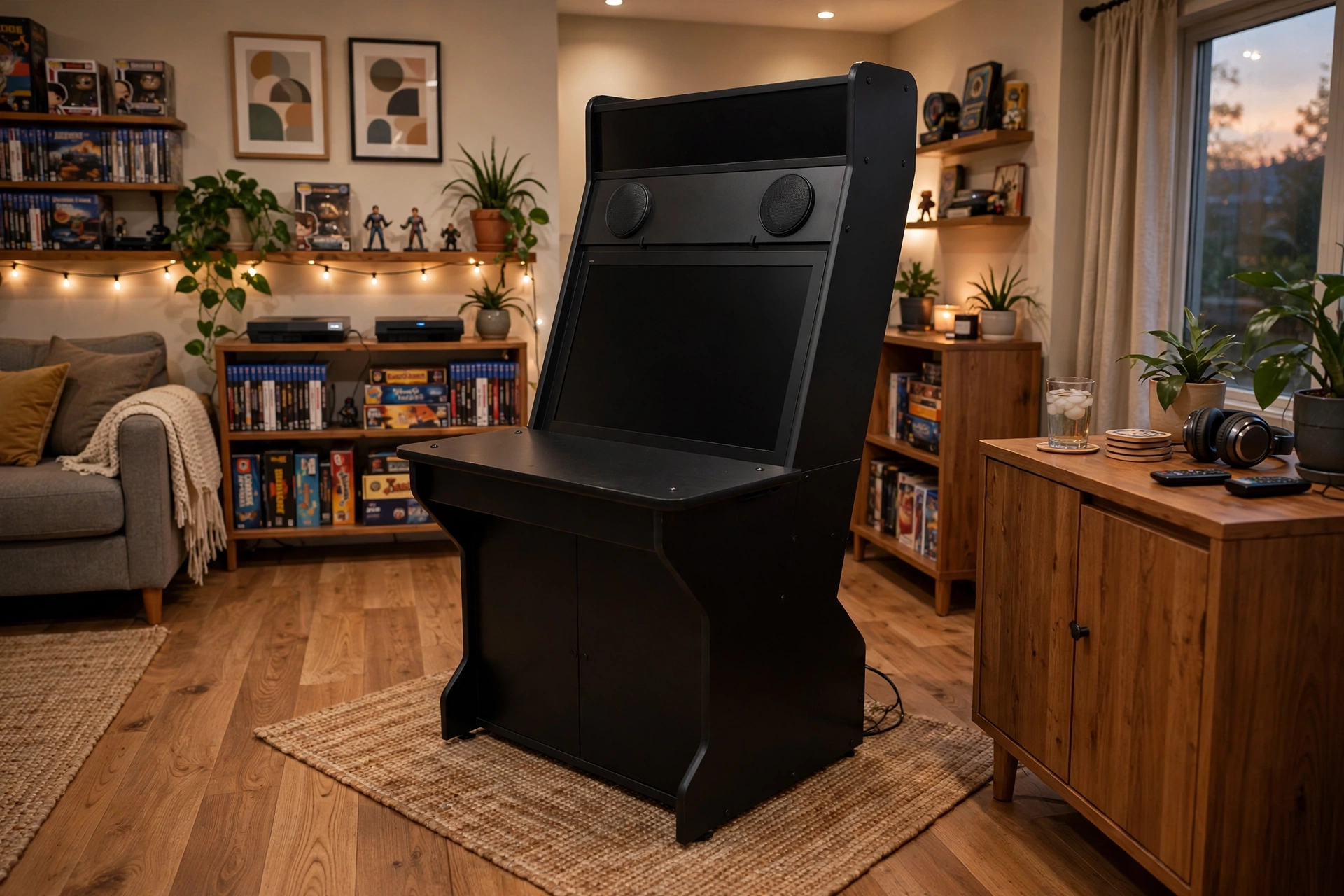
For Canadian buyers already doing the import calculation, consider what a single Xtension purchase actually covers: a fully assembled, arcade-authentic controller that also functions as a statement piece in a home game room. That is a different value equation from a portable stick.
It also scales naturally. If a full arcade cabinet build is already on your radar, a matching pedestal controller from the same ecosystem is a complement, not an afterthought.
Making the Gamepad to Arcade Stick Transition Without Losing Your Ranked Position
Whatever stick or pedestal controller you land on, it won’t feel natural on day one. That’s not a flaw in your choice; it’s just physics. The muscle memory you built on a d-pad or analog stick doesn’t transfer cleanly to a lever gate, and most players experience a period of reduced performance before the new input method clicks, plan for it, don’t panic about it.
Your first hardware decision inside that adjustment is gate shape. Square gates require you to feel for cardinal and diagonal positions at the gate corners, which takes deliberate practice. Octo-gates physically guide the stick into diagonal positions, making early motion inputs more forgiving. Beginners often warm to octo-gates faster; veterans tend to prefer square for precision. Most quality arcade sticks let you swap the gate restrictor yourself, so this isn’t a permanent commitment either way.
Button layout is equally game-specific. A Street Fighter six-button spread and a Tekken eight-button layout are not interchangeable. Buying a stick configured for your primary game eliminates re-learning that has nothing to do with transitioning from a gamepad and everything to do with unfamiliar finger geography.
Live in training mode for the first couple of weeks. Rebuild motion inputs you already know before layering in new ones, and stay out of ranked play until your execution feels stable. Your rating will recover faster with a short break than by grinding fumbled dragon-punch motions in live matches.
Players who push through the adaptation window almost universally say they wouldn’t return to a gamepad. For those considering arcade-authentic, USA-manufactured controllers built for exactly this kind of long-term commitment, the transition cost is genuinely one-time.
Who Should Buy What: A Quick Decision Framework
Once you have committed to making the switch, the next question is simpler than it feels: which type of buyer are you?
Casual players (once or twice a month, no competitive goals): A mid-range arcade stick still beats entry-level on component quality, but be honest with yourself. If the adaptation period described above sounds like more friction than your play frequency justifies, a gamepad is a perfectly respectable answer.
Serious home players: This is the core arcade stick buyer. You play regularly, execution matters to you, and you want hardware that grows with your game. Mid-range to premium arcade sticks are your zone. If you play exclusively at home and portability means nothing to you, the pedestal format deserves a serious look over a portable stick.
Tournament players and FGC participants in Canada: Portability is non-negotiable for bringing your stick to locals. A quality mid-range portable stick with a proper carry case is your practical tournament kit. The pedestal controller is a home complement, not a replacement for what you lug to the venue.
Home arcade builders and game room enthusiasts: The Xtension Pedestal Controller is the natural fit, see the pedestal section above for the full value case.
Still unsure? Skip the entry-level “test” purchase. If you are researching this carefully, you will outgrow budget components fast, and the savings disappear when you buy again at the right tier anyway.
The Bottom Line on Arcade Fight Sticks for Canadian Buyers
Once you know which tier fits your situation, the rest comes down to three checks before you commit.
Buy at the right level from the start. CAD conversion erodes entry-level savings. Mid-range components are the minimum threshold for hardware that will actually hold up as your game improves.
Verify compatibility against your specific console before your order ships, a cross-border return is costly and slow.
Run the full landed-cost math upfront. The USD sticker price is not your price. Once you factor in currency conversion, import duties, and shipping to a Canadian address, a product that looked cheaper can end up more expensive than a domestic option you initially dismissed. Do that math before checkout, not after.
Think about the kind of setup you actually want. If you are building out a home game room and portability is not a priority, the Xtension Pedestal Controller from Rec Room Masters is worth a serious look. It ships fully assembled, uses full-size arcade-grade components, and sidesteps most of the import friction that comes with cross-border stick orders.
The jump from gamepad to arcade stick is genuinely worth making. Give yourself the adaptation window, trust the process, and buy quality. Arcade hardware has a long-standing place at the heart of competitive fighting games, and once the muscle memory settles in, you will feel exactly why.
Conclusion
The research is the easy part; the muscle memory is the real investment. Buy at the right tier from the start, run the full landed-cost math before checkout, and match the hardware to the setup you are genuinely building. If that setup is a dedicated home game room, the Xtension Pedestal Controller from Rec Room Masters deserves a serious look before you default to an imported portable stick.
